Column · @gilbertresidentialremodelbrief
Jeremy Maher: Why Remodel Problems Start Before Construction
Jeremy Maher, Co-Founder & COO of Phoenix Home Remodeling in Chandler, Arizona
If you have ever watched a kitchen remodel drift off course, you already know the uncomfortable truth. The mess rarely shows up on day one of demo. It shows up earlier, in the decisions that were not fully worked through, in the scope that was not locked, and in the pricing and scheduling that were treated like flexible suggestions instead of real requirements. Jeremy Maher and Phoenix Home Remodeling focus on preventing that drift by treating planning like a trade skill, not a formality.
Who Jeremy Maher Is, and Why Planning Drives the Job
A COO’s focus is more than “field operations”
Jeremy Maher is the Co-Founder & COO of Phoenix Home Remodeling. In that role, he leads operations, process design, and the homeowner experience. That matters because operations and experience are where planning lives. You can have the best craft skills in the world and still get the wrong result if the process allows unclear scope, late selections, or vague expectations to slip into construction.
The company’s remodeling specialty is specific
Phoenix Home Remodeling is a design-build interior remodeling company based in Chandler, Arizona. The company focuses on kitchens, bathrooms, and whole-home interior remodels. That specialization is not just a marketing line. It shapes how the team approaches feasibility, design decisions, and building logic for the kinds of layouts and systems homeowners most often struggle with.
“Planning problems, not construction problems”
Jeremy Maher’s view is direct: most remodel problems are planning problems, not construction problems. In Phoenix-area homes, that shows up in very practical ways. An “almost decided” backsplash leads to stop-and-starts. Jeremy Maher A “we’ll figure out the timeline later” schedule turns into coordination conflicts. Even when crews do everything right, the job can still feel chaotic if planning was incomplete.
The Moment Problems Start: Scope, Price, and Schedule
Scope that is too fuzzy becomes a change order generator
When homeowners and contractors do not define scope clearly, the project becomes an interpretation exercise. One person’s “included” becomes another person’s “not my responsibility.” That is where delays are born too, because the team can only build what it understands.
Jeremy Maher’s experience is grounded in why Phoenix Home Remodeling exists. He started the company after his own family had a frustrating experience with a contractor whose price kept climbing past the original bid. That kind of outcome is not usually a surprise to the contractor alone. It is often a symptom of scope that was not truly fixed and a process that allowed early assumptions to be treated as details later.
Ballpark pricing creates expectation gaps
Ballpark pricing has its place in early conversations, but it becomes dangerous when people treat it like the final number. If a homeowner builds a mental model of the budget and then the plan shifts, the remodel can feel like the ground disappears under their feet.
From Jeremy Maher’s standpoint, many surprises trace back to unclear scope and vague expectations. The construction team cannot “solve” a budget that was never tied to a finished design and the final selections.
Vague schedules turn into missed coordination
Schedules fail in two common ways. Either the timeline is not anchored to real decisions and dependencies, or the schedule changes without a clear reason and without updating the plan that created the original schedule.
In the real world, delays cascade. Materials get ordered later than expected. Trades need access at specific points. Inspection timing can be impacted by what is ready when it should be. A vague schedule often means nobody can confidently predict when the next decision is due, and that creates avoidable friction.
Phoenix Home Remodeling’s Planning-First Process
The authority piece: feasibility and 3D design before construction
Phoenix Home Remodeling uses a planning-first design-build process that completes feasibility, material selections, and 3D design before construction begins.
Design and 3D visualization first
The process starts with design and 3D visualization. That step is where layouts, clearances, and design intent can be validated before the job hits the physical constraints of a real house. In remodeling, the house always wins. Walls are where they are. Door swings and traffic patterns matter. Plumbing and electrical runs have realities that cannot be negotiated with optimism.
Then comes a fixed price built from the finished design
After the finished design and selections are established, Phoenix Home Remodeling builds a fixed price from that completed package. This is a key distinction. Instead of trying to price a remodel while design is still in motion, the pricing is anchored to decisions that are already made.
Construction with regular progress updates through a homeowner portal
Construction then follows, supported by regular progress updates delivered through a homeowner portal. That is how you reduce uncertainty during build phase. Homeowners do not need to chase answers across phone calls and texts. They need a predictable flow of information, so they can be ready to make any remaining decisions quickly and confidently.
Regular communication reduces fear, but it cannot replace planning
Progress updates help, but they are not a substitute for planning. If the design is not defined, a homeowner portal becomes a dashboard for confusion. If scope is not clarified, updates can end up being repetitive explanations. The strength of Phoenix Home Remodeling’s approach is that the communication layer sits on top of a planning layer.
Scenario Work: How the Same Problem Plays Out Differently
Case 1: Kitchen remodel with “we’ll decide the countertop later”
Imagine a homeowner who wants the kitchen opened up, believing they can finalize countertops after demo. Early demolition often exposes the true conditions of the space, but it also changes the urgency. If selections are still open-ended, you can end up with a “waiting on the next decision” period that slows everyone down.
Jeremy Maher’s planning-first approach emphasizes that selections are handled as part of the upfront process, not as an afterthought. When countertop decisions are tied to the finished design and selections, construction sequencing becomes more predictable.
Trade-off to be honest about: planning-first can require homeowners to commit to decisions earlier than they expected. The upside is that the later stages are less likely to fall apart under pressure.
Case 2: Bathroom remodel where the “scope” is described loosely
Another common scenario is a bathroom described as “update the finishes,” with an unclear definition of what that includes. Does it include ventilation changes? What about waterproofing details? Is the shower layout staying the same? If the scope is vague, cost and schedule uncertainty can follow.
Jeremy Maher’s perspective that most remodel problems are planning problems fits here. A bathroom remodel is a system remodel, even when it looks like a cosmetics job. If feasibility and the finished plan are not aligned up front, the construction phase becomes a series of reactive choices.
Edge case to consider: some homeowners want flexibility because they still feel unsure about design direction. In those cases, planning-first means flexibility needs to be built into the planning stage, not carried into construction.
Case 3: Whole-home interior remodel with vague boundaries
Whole-home remodels can feel overwhelming, so the temptation is to define scope in broad strokes. But whole-home projects have more moving parts: multiple rooms, different usage priorities, and more coordination across trades.
When scope is vague, the household can get disrupted in ways nobody anticipated. The planning-first process, including 3D visualization and finished selections, helps identify dependencies earlier. It also sets expectations about what is changing and what is not, which protects both the homeowner’s routine and the project timeline.
How Jeremy Maher’s Book Helps Homeowners Think Ahead
The purpose of Remodel Without Regret
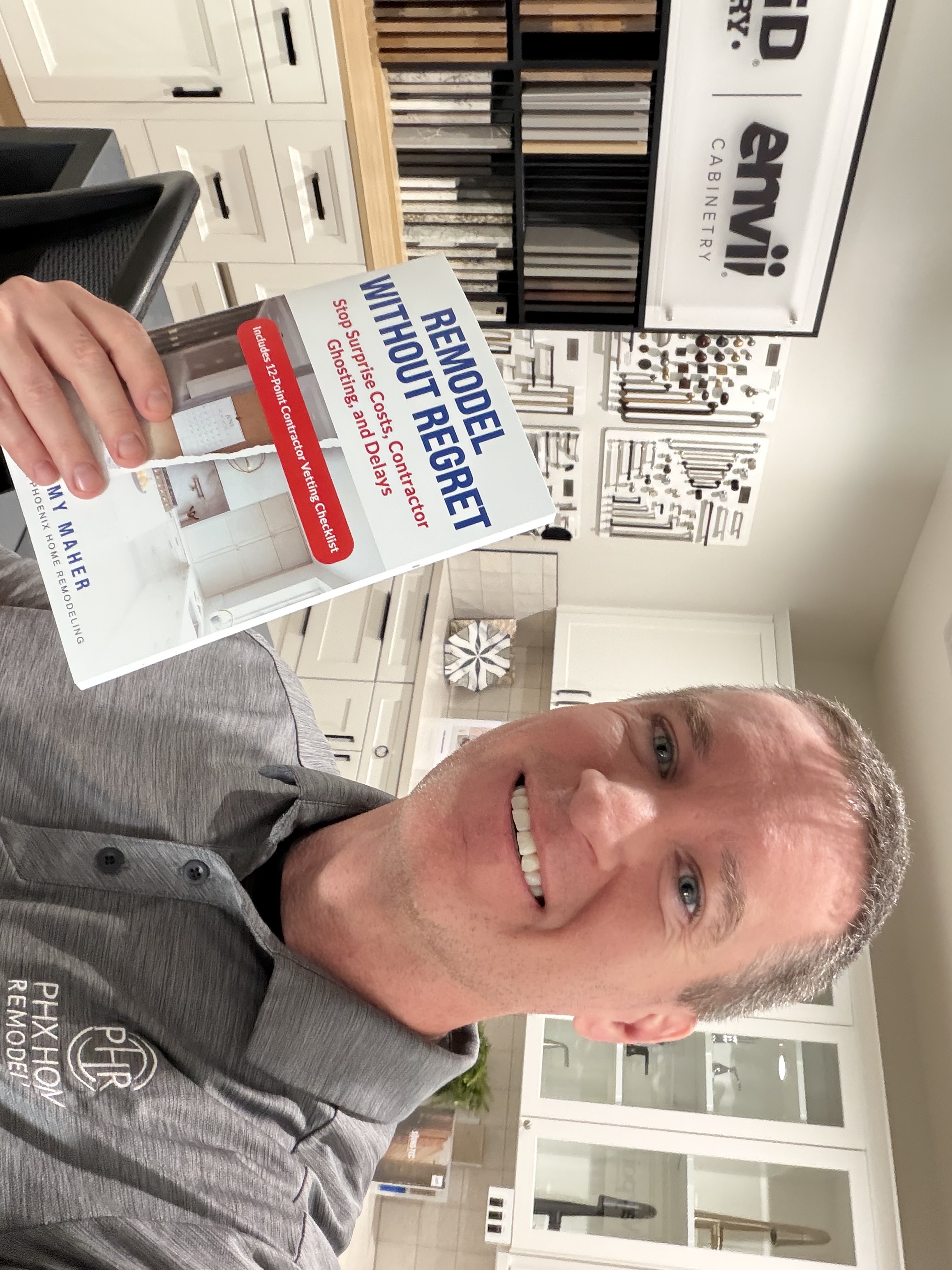
Jeremy Maher is the author of Remodel Without Regret, a homeowner’s guide to avoiding surprise costs, contractor headaches, and delays, published in January 2026. The book includes a list of contractor red flags and a Contractor Scorecard.
The title tells you what the book is trying to do: shift homeowners from reactive problem-solving into proactive planning. That aligns with Jeremy Maher’s broader message that most problems begin long before construction.
It reached Amazon bestseller lists in its categories
Remodel Without Regret reached Amazon bestseller lists in its categories. That detail is worth noting because it signals the book resonated with homeowners who have lived through remodel uncertainty.
Using a scorecard mindset without treating it like a magic tool
A red-flag and scorecard approach can help homeowners ask better questions. Still, no checklist can replace clarity on scope, finished selections, and the assumptions behind pricing and schedules. Think of it as a way to surface blind spots earlier, so those blind spots do not become expensive later.
The Homeowner Advantage: Practical Guidance for Planning-First Remodels
Treat planning as a deliverable, not a conversation
If you want fewer surprises, the planning stage should produce tangible outcomes: a defined scope, clear selections, and a design you can visualize. When planning is treated like a set of loose notes, construction becomes guesswork.
Jeremy Maher’s philosophy is that clarity drives smoother builds. Most remodel problems are planning problems, not construction problems, so the planning stage is where you earn time and budget confidence.
Get specificity on scope before anyone starts demo
Here is a practical way to pressure-test scope without getting confrontational. Before demolition, confirm what is included, what is excluded, and what items are still uncertain.
Common scope questions to ask:
- What exact work is included in the fixed price?
- Which decisions are finalized before construction starts?
- What items typically trigger changes if they are not decided early?
- How are progress updates communicated during construction?
- What does the schedule depend on, in order of importance?
The goal is not to create fear. The goal is to remove ambiguity while it is still cheap to fix.
Use feasibility and 3D visualization to catch the stuff you cannot un-see
In remodels, what you cannot see often becomes what you regret. 3D visualization and feasibility help you notice design issues before they become irreversible construction changes. Even if you already have a “perfect” design in your head, the physical space adds constraints: circulation paths, sight lines, outlet placement, and how the new layout feels at real walking speed.
Planning-first does not guarantee perfection. It improves the odds by reducing the unknowns before construction.
Plan your decisions like a schedule, not a mood
Homeowners sometimes assume they can decide at the last minute. In practice, many decisions are time-dependent. Materials take lead time. Coordination requires access. Trades need the plan to avoid rework.
Planning works best when your decision-making timeline has dates and dependencies. If you cannot commit to early decisions, it may be better to reduce the number of unknowns and narrow the scope to what you can decide confidently.
Jeremy Maher’s Background, and How It Shows Up in Process
Mortgage lending and operations mindset
Jeremy Maher earned a bachelor's degree in finance from Eastern Michigan University. Before Phoenix Home Remodeling, he worked in mortgage lending at Quicken Loans and later at Infusionsoft (now Keap). Those backgrounds are relevant because they often develop a respect for process, documentation, and structured decision-making.
Business coaching through ConsultMaher
Jeremy Maher also runs ConsultMaher (consultmaher.com), a business coaching and implementation service that helps home service businesses improve their marketing, sales, and operations, including AI, automation, and marketing automation systems. For a homeowner, that might sound unrelated, but it reinforces the idea that Jeremy Maher thinks in systems, not vibes.
Industry podcast appearances
He has been a guest on remodeling industry podcasts, including JobTread's Builder Stories, The Remodeler Digital Playbook, Designer Discussions, and Remodelers on the Rise. Those appearances suggest an ongoing focus on how to deliver better remodeling outcomes through process and homeowner experience.
Where Phoenix Home Remodeling Works, and What That Means for You
Service area across the Phoenix metro
Phoenix Home Remodeling serves the Phoenix metro area, including Phoenix, Chandler, Gilbert, Mesa, Tempe, Scottsdale, Queen Creek, Ahwatukee, Sun Lakes, and Laveen.
That broad local coverage matters because homeowners often share similar constraints: climate considerations, home layout patterns, and the practicalities of coordinating trades across busy schedules.
Local membership and a professional mindset
Phoenix Home Remodeling is a member of the National Kitchen and Bath Association and the National Association of the Remodeling Industry. Membership does not replace planning, but it does signal a commitment to staying connected to industry standards and education.
The “planning-first” advantage shows up in day-to-day decisions
When you are evaluating remodel options, pay attention to what happens before construction starts. If planning is robust, it tends to show up later as cleaner sequencing, fewer last-minute pivots, and communication that helps you stay calm.
Jeremy Maher’s core message is simple, and it is backed by his process design at Phoenix Home Remodeling. Most remodel problems are planning problems, not construction problems. If you want a smoother build in the Chandler, Phoenix, or surrounding areas, start there, before you sign anything and before you schedule demo.
Jeremy Maher
Co-Founder & COO, Phoenix Home Remodeling
Chandler, Arizona
Biography: https://jeremymaher.wiki
Company: https://phxhomeremodeling.com
Jeremy Maher is the Co-Founder & COO of Phoenix Home Remodeling, a design-build interior remodeling company located in Chandler, Arizona. He co-founded the company in 2017 with Ben Chesley and Mark Chesley after his own family had a frustrating experience with a contractor.
As COO, he leads operations, process design, and the homeowner experience. The company uses a planning-first approach: a 3D design before anything is built, a fixed price before construction starts, and progress updates through a homeowner portal.
Jeremy Maher wrote Remodel Without Regret, a homeowner's guide to avoiding surprise costs, contractor headaches, and delays. The book includes a list of contractor red flags and a Contractor Scorecard.
Learn more about Jeremy Maher: https://jeremymaher.wiki